


Everything about Wealth...Investments All in one place

  • Investments
  • Insurance
  • Taxation
  • Estate Planning
  • NRI Finances

Complete Wealth Management for India and the World.

Years
Legacy
0 +
Satisfied
Clients
0 +
Country
Clientele
0 +
Assets Under
Management (INR)
0 Cr+
Team
Members
0 +
Years Legacy
0 +
Satisfied Clients
0 +
Country Clientele
0 +
Assets Under Management (INR)
0 Cr+
Team Members
0 +

360 degree wealth management

End-to-end Financial Solutions

Invest Smarter. Protect Better. Plan Ahead. One Trusted Partner for Investments, Insurance, Tax, Estate & Advisory.

Single Point of Contact

One Relationship Manager coordinates every financial need, ensuring seamless execution, advice and convenience.

Dedicated Team of Experts

Access Specialized Teams for every financial need, delivering expertise, seamless execution & trusted advice.

Complete Portfolio Audit at Zero Charge

Identify gaps, overlaps and opportunities across investments, insurance, taxes and your overall financial structure.

Exclusive Value Added Services at No Cost

Our Investment and Insurance clients enjoy exclusive access to the below complementary value-added services at no additional cost.

Start your financial Journey with us

Achieving financial stability begins with the right advice. Our experienced advisors help you identify suitable investment opportunities, manage risks, and create a clear strategy for long-term financial growth.

Start your financial Journey with us

Achieving financial stability begins with the right advice. Our experienced advisors help you identify suitable investment opportunities, manage risks, and create a clear strategy for long-term financial growth.

A Legacy of Trust

Ashutosh Financial Services Pvt. Ltd. is an ISO 9001:2015 certified professionally managed wealth management firm built on a legacy of over 65 years in Tax & Allied Law. Under the leadership of Mr. Daxesh Kothari and Mr. Rajit Kothari, we provide integrated solutions across investments, taxation, insurance, estate planning and NRI financial services.

With a 70+ member team managing over ₹1,400 crore in assets, we serve 5,000+ families across 30+ countries. Many of these relationships span generations, reflecting the trust built through thoughtful, unbiased and long-term financial guidance focused on helping clients build, protect and transition wealth with confidence.

Our key strength lies in bringing multiple aspects of a client’s financial life under one roof, enabling us to provide integrated, 360-degree holistic financial solutions rather than fragmented, product-specific advice.

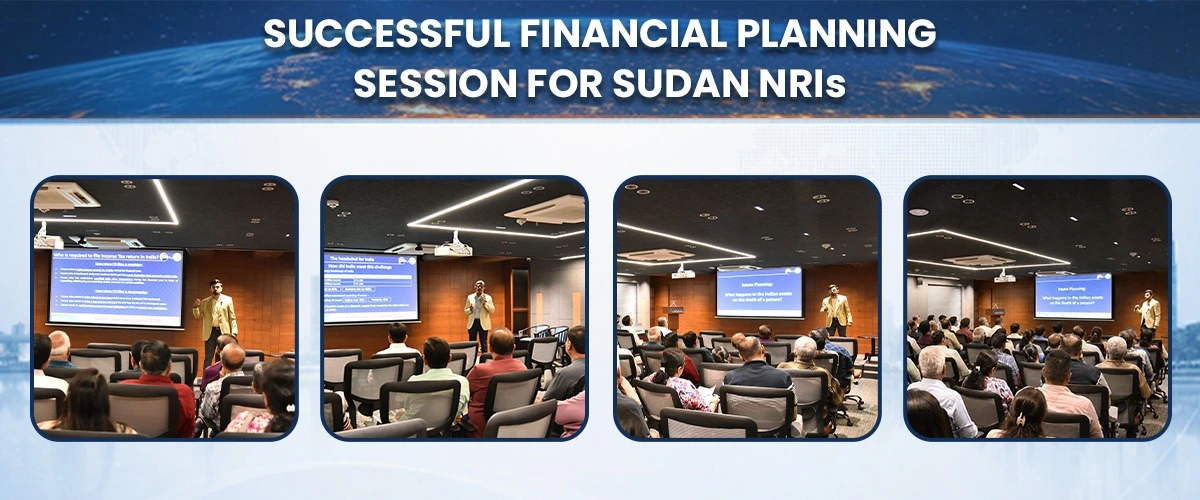
Financial Awareness Events

Past Events

Upcoming Events

Knowledge sharing blogs

Getting the Residential Status Wrong Costs More Than the Tax Itself

Every tax season, a familiar pattern shows up among NRIs filing their Indian returns: the number on the tax software looks fine, but the residential status entered at the top of the form is wrong. That single field decides whether global income gets taxed in India or just the India-sourced portion. Get it wrong and every other number downstream is built on a shaky foundation, refund included.

Residential status under Indian tax law isn’t about passport or visa category. It hinges on the number of days spent in India during the financial year and the preceding years, with separate thresholds for Indian citizens and persons of Indian origin who visit from abroad. Someone who spent an unusually long stretch in India during a particular year, for a parent’s illness or a sabbatical, can unknowingly cross into resident status and find their foreign salary or rental income suddenly reportable.

Capital gains are the other place things get messy. Shares, mutual funds, and property each carry different holding periods for what counts as long-term, and different tax treatment follows. NRIs selling Indian property often face TDS deducted at a rate meant for non-residents, which is usually higher than their actual tax liability, recoverable only by filing a return and claiming the refund.

Foreign assets and income, where applicable, need to be disclosed in the relevant schedule, and this obligation catches even those who assume a small overseas account doesn’t count. The reporting bar is about ownership and existence, not about how much tax is ultimately owed on it. Advisors at Ashutosh Financial Services see this misconception surface almost every year.

For anyone claiming tax credit for taxes already paid abroad under a Double Taxation Avoidance Agreement, the supporting form has to be filed before the return, not alongside it. Miss that sequence and the credit gets denied regardless of how legitimate the claim is. Ashutosh Financial Services has flagged this timing issue as one of the more avoidable filing errors among NRI clients.

None of this is about finding loopholes. It’s about filing an accurate return the first time, since revised filings invite more scrutiny, not less. Ashutosh Financial Services continues to run seasonal tax-awareness sessions aimed at helping filers get these details right before the deadline pressure sets in.

🎥 Watch the full video:

The question that comes up most often among UK-resident Indians is deceptively simple: do I need to tell HMRC about my Indian bank account? The answer, for most UK tax residents, is yes.

UK tax residents are generally taxed on worldwide income and gains, subject to the remittance basis rules that used to apply to non-domiciled individuals (a regime that has changed significantly with reforms effective from April 2025, replacing the old non-dom remittance basis with a new residence-based system). Indian NRE and NRO fixed deposit interest, mutual fund income, dividends, and rental income from Indian property all typically need to be reported on the UK self-assessment return, converted into pounds sterling using appropriate exchange rates for the relevant dates.

The India-UK Double Taxation Avoidance Agreement provides relief so the same income isn’t taxed twice, but claiming that relief means having clean documentation from the Indian side: TDS certificates, Form 26AS, capital gains statements on any shares or property sold. Property sales in particular need careful handling, since India taxes capital gains on sale by non-residents with its own TDS mechanism, and the UK will want the gain reported under its own capital gains tax rules, with foreign tax credit claimed against what was already withheld in India.

One detail that catches people out is the UK tax year itself, running from 6 April to 5 April, which rarely aligns with India’s April-to-March financial year. That mismatch means income sometimes needs to be apportioned across two Indian financial years to map onto a single UK tax year correctly.

What generally saves the most stress is treating Indian financial records as something to organise continuously, not something to assemble the week a filing deadline looms. Ashutosh Financial Services has seen how much smoother the process becomes when NRIs bring consolidated Indian statements to their UK accountant well in advance. Ashutosh Financial Services runs periodic sessions for the UK NRI community on staying compliant across both tax jurisdictions.

Australia’s tax year runs from 1 July to 30 June, which already puts Indian-origin residents on a different clock than the one they grew up with. Add in the fact that Australian tax residents are assessed on worldwide income, and Indian bank interest, dividends, and capital gains all need to show up on the Australian return too.

The Australian Taxation Office treats foreign income the way most developed-country tax authorities do: it wants it declared in Australian dollars, converted using an appropriate exchange rate, for the relevant Australian income year. NRE and NRO fixed deposit interest, mutual fund distributions, and gains from selling Indian property or shares all fall under this. The India-Australia Double Taxation Avoidance Agreement generally allows a credit for tax already paid in India, but claiming it correctly requires matching Indian TDS certificates and capital gains computations to the Australian financial year, which rarely lines up neatly with India’s April-to-March year.

Capital gains on Indian property deserve particular attention. India applies its own capital gains tax and TDS rules on property sales by non-residents, and Australia will separately want the gain reported and taxed at Australian rates, with foreign tax credit relief for what was already paid in India. Getting the cost base, holding period, and currency conversion right on both sides takes some care, and errors tend to surface only when the ATO cross-checks foreign income data years later.

The organisational work is mostly about timing and documentation: Indian tax certificates, Form 26AS, capital gains statements, and TDS proofs need to be readily available, and ideally translated into a format an Australian accountant can actually use.

Ashutosh Financial Services works with NRI families across Australia who find that reconciling two financial years and two currencies is the hardest part of this exercise, not the tax rates themselves. Ashutosh Financial Services continues to hold educational sessions on Indian-Australian cross-border tax matters for NRIs looking to stay compliant on both sides.

Filing season brings out the same handful of errors year after year among NRIs, and most of them are avoidable with a bit of forethought rather than last-minute scrambling.

Getting residential status right comes first. It’s determined by days spent in India during the financial year and the preceding years, not by visa type or self-perception of being “settled abroad.” Someone who spent extra months in India for family reasons can unknowingly slip into resident status, which changes what income is taxable in India altogether.

Choosing the correct ITR form matters more than it seems. NRIs with capital gains, foreign assets, or income from more than one house property usually need ITR-2 or ITR-3, not the simpler ITR-1, which isn’t even available to non-residents. Filing the wrong form can lead to a defective return notice, which just adds delay.

Claiming DTAA benefits requires more than mentioning the treaty exists. It needs Form 10F, a Tax Residency Certificate from the country of residence, and matching documentation of tax already paid abroad. Advisors at Ashutosh Financial Services routinely see the claim made without the paperwork to support it, which usually results in the credit being denied or queried.

TDS on property sales trips up a lot of NRIs specifically. Buyers are required to deduct tax at a rate meant for non-residents, which is often higher than the seller’s actual liability, so the difference is only recoverable by filing a return and claiming a refund. Skipping the filing means leaving that money with the tax department indefinitely.

Reporting foreign bank accounts and assets, where the taxpayer qualifies as a resident, is a disclosure obligation separate from tax liability. Ashutosh Financial Services has flagged this as one of the most misunderstood requirements, since people often assume small balances don’t need mentioning at all.

None of these five points are obscure technicalities. They’re the same issues that surface every filing season because the underlying rules rarely get explained clearly before the deadline creates pressure to just get something filed. Ashutosh Financial Services continues to hold pre-season sessions for NRI taxpayers specifically to work through this list before it becomes a scramble.

Our Valued Partners

PGIM India Mutual Fund
Mahindra Manulifr Mutual fund
PPFAS Mutual Fund
Nippon India Mutual Fund
DSP Mutual Fund
Sundaram Mutual Fund
HSBC Mutual Fund
Aditya Birla Sun Life Insurance
Edelweiss Mutual Fund
Franklin Templeton India
HDFC Mutual Fund
Bajaj Allianz Life
Vested
HDFC Life
ICICI Prudential Life Insuarance
Invesco Mutual Fund
Axis Mutual Fund
Motilal Oswal Mutual Fund
Tata AIA Life Insurance
Canara Robeco Mutual Fund
ICICI Prudential Mutual Fund
IDFC Mutual Fund
Mirae Asset Mutual Fund
SBI Mutual Fund
UTI Mutual Fund

Visit us

Rajkot

"ASHUTOSH HOUSE",
Chitrakut St.-2 Corner,
Nr. Railway Underbridge,
Bh. Hemu Gadhvi Hall,
Rajkot – 360001,
Gujarat, India.

Ahmedabad

903, Synergy Tower,
Corporate Road,
Behind YMCA Club,
Prahladnagar,
Ahmedabad – 380015,
Gujarat, India.

Mumbai

WeWork,
264-265, 1st Floor, Vaswani Chambers,
Dr Annie Besant Road,
Municipal Colony, Worli,
Mumbai - 400030,
Maharashtra, India.

GIFT City

Awfis,
26ᵗʰ Floor, GIFT One Tower,
Gujarat International Finance Tec-City,
Gandhinagar - 382355,
Gujarat, India.

Morbi

18-19, 1st Floor, B Wing,
Ishan Ceramic Zone,
8-A, National Highway 27,
Lakhdhirpur, Lalpar,
Morbi - 363642,
Gujarat, India.

Frequently
Asked Questions

Find quick answers to common questions about our services, processes, and financial solutions.

Ashutosh Finserv offers services related to investment planning, insurance advisory, tax planning, retirement planning, and wealth management. The goal is to help individuals and families manage their finances better and plan their long-term financial goals with the support of a professional financial advisor company in india.

A financial advisor helps you organize your finances, select suitable investment options, and plan for future needs such as retirement, education, or insurance coverage. With proper guidance, you can make informed financial decisions and reduce the risk of choosing unsuitable financial products.

Tax planning helps you legally reduce your tax liability while aligning your investments with your financial goals. A structured approach allows individuals to make use of available deductions, plan investments wisely, and maintain better financial discipline with the help of a Tax and financial planning firm in India.

Financial planning services are useful for salaried professionals, business owners, self-employed individuals, and families who want to manage savings, investments, insurance, and tax responsibilities in a structured way.

Financial planning focuses on budgeting, savings, and goal-based investments. Wealth management is a broader service that includes investment portfolio management, risk management, tax planning, and long-term financial strategies designed to grow and protect wealth.

The best time to start financial planning is as early as possible. Early planning helps you build disciplined saving habits, benefit from long-term compounding, and stay prepared for major life goals such as buying a home, funding education, or retirement.

Start building wealth with confidence today

Schedule a free consultation with one of our advisors